Remember to check the Categories and Tags (Science)
This is a quite detailed report but remember that all science experiments should be recorded in detail. The more detail and science, the more chance of hitting Legend. This report is at least a Pro level and at times a Legend but could use even more detail to really take it to the next level.
There are lots of areas for adding videos and pictures of your work. You could make it into a poster (I’ll show you how to do that next time).
Hypothesis (What I think will happen)
I think that the small/big plane will fly further because …
Background
In the background section include some simple facts you find online. You can also link in a Youtube video (just make sure it says what you want it too!).
You can use my background for this blog. This wont always happen though.
The first paper plane was made around 200 years ago.
The longest distance ever flown by a paper plane was 88.1 metres.
There are four forces that act on the paper plane when it is flying.
This video shows some information about how paper planes fly. I thought that it does a great job explaining how to make a great paper plane.
Equipment
List everything you used that is needed to repeat the experiment. No need to rewrite, use this one.
A4 paper
A5 paper
Chalk
Metre stick
Steps (Method)
This is where you put in what you did.You do need to add your bit here as my plane is probably different from yours.
Here’s a video of me folding a paper plane (insert video here – you can talk on the video as well)
Or:
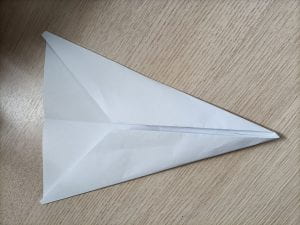
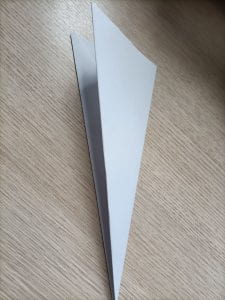
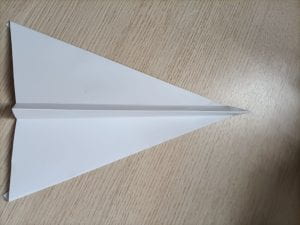
Here are a series of pictures showing how to fold the planes.
Fold paper in half
Fold the ends
Fold the ends a second time
Fold in half
Fold the wings out
We then drew a line with chalk to mark the starting line. Then we took turns throwing the two planes and marking (or taking pictures) or which flew further.
We repeated the throw 3 times.
Results (What we found out)
The big/small plane flew further.
(Insert video or pictures here)
Or..
We measure how far each plane travelled using a metre ruler. The results are shown on this table.
Attempt
Big plane
Small plane
1
5.6
2.3
2
1.8
3
3
4.6
1.6
Average distance
3.3
2.3
Conclusion (what it means)
This is where you look at your data and think WHY did that happen?
The big/small plane flew further than the other plane.
Why I think that the small/big plane flew further because it has .….
I did some research and found out that planes with bigger wings fly further because they can generate more lift. Here is a Youtube video explaining why. Especially at 5.30 where he talks about bigger wings generating lift.
This website also has a great explanation about wing sizes a nd lift. It also talks about birds which is our teachers favourite thing so I’ll get extra points for adding this!
Here, write or make a video on how you would change your experiment if you had to do it again. Talk about the first time you did it when you didn’t make it a “Fair” test.